Introduction
Jump to a section2 sections in this chapter
A Mental Model of Freight Trading
A model often evokes images of dry, academic procedures. Yet, the aim of this book is more pragmatic. It offers a mental model of freight trading inside commodity supply chains. The goal is to bridge the gap between random guesswork and systematic reasoning rooted in economic theory. When applied consistently, this model functions as an "operating system" for navigating a market that is complex, competitive and highly interdependent.
The ambition is not to build a rigid model that "predicts" freight rates. Freight is shaped by a range of interacting forces: volatile fuel prices, shifting seasonal harvests, geopolitical disruptions, operational bottlenecks and fluctuating global demand. Any model that pretends to forecast perfectly will fail. A rule of thumb from the front line is that a trading company normally gets six out of ten right, but cuts its losses on the four losers and lets the six winners run. The mental model in this book is designed to be adaptive and robust: it helps the practitioner form a view, test it, update it and make decisions under uncertainty when reality deviates from plan.
To do that, this book combines inductive and deductive reasoning Mark Saunders and Philip Lewis and Adrian Thornhill (2009). Induction begins with observing real-world recurring patterns and proposing theories grounded in actual data. Deduction challenges these explanations, testing whether the proposed hypothesis holds across time, routes and conditions, and whether alternative explanations fit the evidence better. This “stress-testing” mindset reflects a falsification principle: rather than collecting evidence only to confirm a view, the analysis actively looks for observations that could invalidate it. This balance between theory-building and rigorous testing helps make the framework more resilient.
Because the real world always exceeds what any model can capture, the book treats analysis as the use of mental models, which are simplified representations that make complex adaptive systems manageable. That creates a trade-off. Simplicity makes decisions possible, but it also means important details are filtered out such as risk preferences, charter-party nuances, and shifting operational constraints. The practical implication is straightforward: treat models as tools rather than truths, and keep updating them as new information arrives.
The central theme across the book is price. Prices coordinate fragmented supply chains across actors, regions and times. Freight is not merely a cost in commodity trading; it is one of the key channels through which imbalances are resolved. Understanding Bulk Commodity Supply Chains explains how this logic applies within bulk commodity supply chains, while Structure of the book: From Market Fundamentals to Risk Adjusted Decisions. summarises the structure of the book.
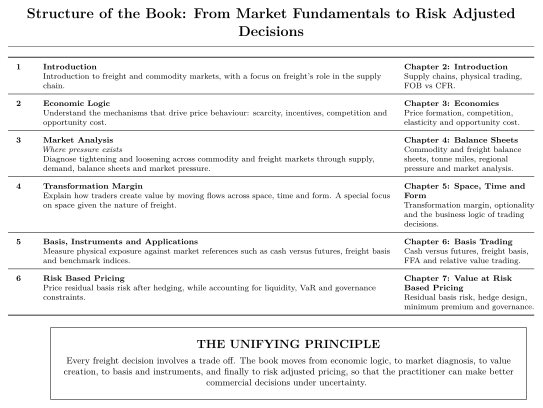
Structure of the book: From Market Fundamentals to Risk Adjusted Decisions.
Understanding Bulk Commodity Supply Chains
Bulk commodity supply chains involve the transportation of bulk cargoes such as agricultural products, iron ore and coal. They matter immensely for the global economy as they are essential for global food and energy security, economic stability and daily life. The distribution of these commodities moves through a sequence of links and nodes. At origin, raw materials are produced or extracted in surplus regions (for example, grain in major exporting areas, iron ore near mines, or coal in producing basins), collected and stored in appropriate facilities, and then moved by truck or rail to ports or rail terminals. From there, cargo is loaded onto bulk carriers for sea transport to importing regions such as Europe, Asia, or Africa. At destination, it is discharged and processed further or delivered to downstream channels serving industrial users and distributors, such as mills, power plants, steelworks, factories, or retailers. Rather than functioning as one centrally managed end-to-end pipeline, a bulk commodity supply chainSupply ChainThe entire process of producing and delivering agricultural products from farms to consumers.Open in terminology consists of links managed by different actors with varied incentives and constraints. Therefore, the overall efficiency and reliability of the bulk commodity supply chains depend on how well these links coordinate.
We define a supply chain as follows: “A supply chain is defined as a set of three or more entities (organisations or individuals) directly involved in the upstream and downstream flows of products, services, finances, and/or information from a source to a customer.”John T. Mentzer and William DeWitt and James S. Keebler and Soonhong Min and Nancy W. Nix and Carlo D. Smith and Zach G. Zacharia (2001)
Pricing is the primary mechanism that coordinates individual links and holds the supply chain together. Prices such as commodity prices, freight rates, exchange rates and storage costs convert vast amounts of dispersed information into price signals that guide decisions throughout the supply chain. When these prices move, the supply chain adjusts: commodity flows are rerouted, inventories move across regions and time, and profit margins shift from one segment to another. In this way, price changes actively reshape the supply chain in terms of who ships what, when and where.
Trading is what turns these price changes into the physical movement of bulk commodities in the supply chains. It connects buyers and sellers across geography and time under uncertainty. Trading is not just about "buying low and selling high" activities. As shown in Vertical supply chain view showing the trader as a parallel value-adding layer across the execution chain. The trader creates value by reducing transaction costs, coordinating logistics and contracts, providing finance, and bearing risk between export and import., the trader operates a parallel chain alongside the vertical physical chain. The physical chain is relatively linear, linking origins, transportation and delivery into one continuous flow. However, it cannot manage the commercial and financial layer around the trade: price exposure, freight fixing, documentation, financing, insurance and credit. That is where the trader creates value alongside the physical supply chain by reducing transaction costs, coordinating logistics and contracts, providing finance, and bearing risk between origin and destination markets.
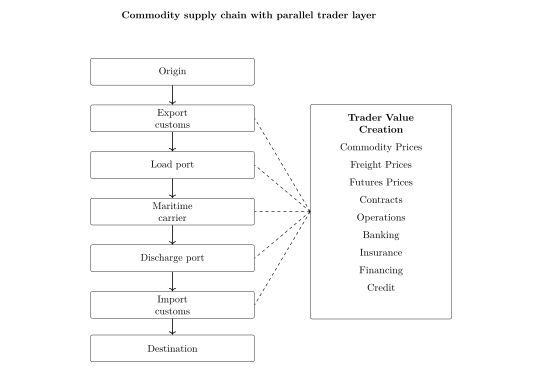
Vertical supply chain view showing the trader as a parallel value-adding layer across the execution chain. The trader creates value by reducing transaction costs, coordinating logistics and contracts, providing finance, and bearing risk between export and import.
To make it more tangible, imagine a wheat trader that buys Free on Board (FOB) at an export port and sells Cost and Freight (CFR) to a wheat mill in North Africa. A vessel that arrives late could miss its laycan, meaning that it fails to arrive at the loading port and tender valid notice of readiness by the cancelling date. The margin can then vanish through additional storage costs, contractual penalties or a cancelled sale.
The trader protects the deal by keeping options open, for example switching to an alternative vessel or rolling hedges so price risk stays covered while timing slips. Another example is when the buyer's bank rejects the presented documents because they do not conform to the letter of credit (LC). Here, the trader creates value by resolving the discrepancy quickly: coordinating any LC amendments among the buyer, seller and banks and ensuring that the documents conform to the LC. In both cases, the trader's edge is coordinating these links, preventing execution issues and absorbing the execution risk that neither farmer nor buyer wants to carry.
At the centre of this trading system is the human element. Markets do not react mechanically; in fact, they are shaped by traders' ability to translate various price signals into decisions about physical flows. To make such decisions, traders must blend economic reasoning with a good understanding of geopolitics, logistics constraints and market psychology. Their decisions are made in high-pressure environments where information is incomplete, timing is critical and small errors can have significant financial implications. At the same time, traders need to adapt to a rapidly changing world, where changes in consumer demand patterns, trade policy, technology, climate impacts and geo-economics constantly reshape the trading environment. This work requires not only technical capabilities, but also critical thinking and ethical considerations to outperform competitors. The decisions made by traders can affect employment, economic stability and access to essential goods for populations worldwide.
Physical Trading
Before we examine the commodity supply chain, we need to understand what a trade looks like in practice. Physical tradingPhysical tradingThe buying and selling of commodities with actual or potential delivery, together with the management of logistics, quality, documents, finance and contractual performance.Open in terminology is the buying and selling of commodities with actual delivery from producers to buyers. Traders are responsible not only for price-making but also for managing the physical process: assembling volumes, arranging storage, delivering on contract terms to meet customer specifications and maximising profits Craig Pirrong (2015). Responsibility across an FOB-CFR trading chain. Note that the figure is arranged to be read from top to bottom by phase. The dashed horizontal line marks the load port point where FOB delivery occurs and risk transfers to the buyer under CFR. illustrates this as an FOB-CFR trading chain arranged by phase. In the contracting stage, the producer offers an FOB cargo and specifications, the trader converts this into a back-to-back position by buying FOB and selling CFR, and the buyer agrees the CFR purchase. At origin, the producer prepares the cargo and export documentation, while the trader books the vessel and coordinates the loading plan. The dashed line marks the critical handover at the load port: once the cargo is on board, the FOB delivery is completed and risk transfers under the CFR sale, even though the trader still controls the onward carriage. From that point on, the trader manages the execution of the freight and the bill of lading, while the buyer pays and receives the shipping documents before handling import and discharge. In other words, the trader sits in the middle translating an origin-side FOB process into a destination-side delivered transaction, carrying the execution risk that arises around loading, freight performance, and document conformity.
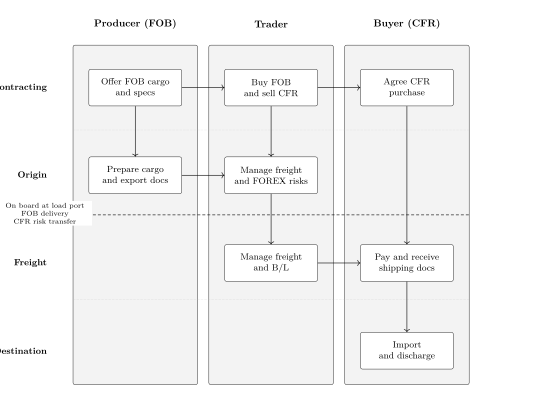
Responsibility across an FOB-CFR trading chain. Note that the figure is arranged to be read from top to bottom by phase. The dashed horizontal line marks the load port point where FOB delivery occurs and risk transfers to the buyer under CFR.
Physical trading therefore allows two things at once: getting the price right and getting the process right. Once a trader has turned an origin-side FOB offer into a destination-side CFR sale, the position is only profitable if it is executed as the contracts require. The commercial idea of "buying FOB, selling CFR" may sound simple, but the reality is operational. When reality deviates, the edge is the trader's ability to solve problems quickly without letting costs, delays or claims erode the margin.
In that sense, today's physical trader has evolved from a merchant who historically travelled to source and sell into a specialised coordinator. Modern commodity markets are far too complex for generalists to manage. Specialisation is essential because physical trading now relies on deep market knowledge, logistics networks and practical expertise. Large trading firms may operate across multiple commodity clusters, but they typically do so through specialised teams. Scale helps mainly through shared infrastructure, stronger banking relationships and the ability to manage risk across many flows, rather than through any single team covering everything.
Physical trading spans broad commodity groups, which are generally grouped into four clusters: energy, agricultural commodities, soft commodities and metals. Each cluster comes with its own distinct trading mechanisms, logistics, storage, and pricing dynamics. This is why firms organise into specialist desks.
Energy is by far the largest cluster Craig Pirrong (2018), covering crude oil, refined products, coal, natural gas and electricity. These markets are shaped by the need for continuous and uninterrupted supply. When supply is constrained, the marginal energy supply matters disproportionately, and small disruptions can drive large price moves. Storage constraints are central: electricity storage is limited by cost and duration, while gas storage is capacity constrained and location dependent. In such a setting, prices can behave in counter-intuitive ways, turning to negative prices as market participants may pay others to take surplus output if it represents a more economically sound decision than to store it, or if the seller has run out of storage capacity. Notable companies active in energy trading markets include Vitol, Trafigura, Shell and British Petroleum (BP).
Agricultural commodities cover grains and oilseeds such as wheat, corn, soybeans, barley, rapeseed and rice. These markets are shaped by harvest cycles, weather, yield expectations, food demand, animal feed demand and biofuel policy. Storage is possible, but quality, moisture, grade and location matter, so the spread between local cash prices and futures prices is central to trading. Logistics are also important because crops must move from inland growing regions to export terminals, processors and end users. Demand for staple food commodities is relatively insensitive to price in the short run because these goods are necessities.
Soft commodities include sugar, coffee, cocoa, cotton and even orange juice (yes, orange juice even has a futures market). These markets are substantial, even though they often receive less attention outside specialist circles. Production is concentrated in tropical regions, so supply of these commodities is often shaped by weather risk, crop disease or political instability. Traders often "go to origin," engaging directly with farmers, suppliers and local exporters. This practice may sound adventurous, but it usually involves more spreadsheets than safari hats. Participants include large agribusiness groups (ADM, Bunge, LDC and Cargill) as well as specialist traders like Czarnikow, SUCDEN and EDF Man.
Metals trading in a formalized form dates back to the 19th century when the London Metal Exchange (LME) was established. Metals can often be stored for long periods without spoilage, so warehousing becomes central to the trading logic. That links directly to carrying costs, stock levels and inventory management. Large trading firms include Trafigura, Glencore and IXM. Metals are often discussed as:
Base Metals: Aluminium, Copper, Lead, Nickel, Tin, Zinc.
Precious Metals: Gold, Silver, Platinum, Palladium.
Speciality Metals: Tantalum, Cobalt, Molybdenum, and others.
Ferrous Metals: Iron ore, Steel.
Across all these commodity clusters, the common theme is the same: physical constraints and logistics shape what can be traded, when it can be traded and at what cost. This is where freight becomes essential. Freight is not an "add-on" to the trade. It is a link that turns an origin price into a delivered price and connects surplus with deficit, supply with demand. The "Law of One Price" suggests that identical goods should converge in value across locations, with any price differences largely explained by transportation costs. In the real world, convergence is imperfect. Frictions, such as vessel delays, port congestion, weather disruption and default risk, create gaps between "theoretical" and "achievable" delivered prices. Those gaps are not just noise; they are exactly the space where traders operate, turning inefficiencies into tradable opportunity.
Freight as a Strategic Link
Freight is the backbone of the commodity markets because it turns "where goods are produced" into "where goods can be consumed". Its importance extends beyond mere logistics; it is the vital link that connects producers with global markets and enables the smooth functioning of commodity supply chains. Freight as the strategic link in bulk commodity supply chains shows this logic as a simple bulk supply chain. Upstream, commodities originate at farms or mines in surplus regions. They must be assembled and stored, moved to an export terminal, and made "shippable" through handling and documentation. The freight market sits in the middle, linking export and import systems. Downstream, the cargo flow continues through an import terminal to the processor or end user in a region with a deficit of goods. In this setting, trade works only when the destination buyer is willing to pay enough to cover (i) the commodity value at origin and (ii) the full cost of moving it through every step of the chain: inland assembly, storage, port handling, ocean freight and import handling. When any link becomes scarce, for instance terminal congestion or vessel unavailability, freight costs rise and timing becomes uncertain. Under that scenario, freight is no longer a logistical link but the bottleneck that determines whether a cargo can move.
The soybean trade is a concrete example of how this bottleneck shows up in practice. Soybeans are available inland in Brazil, while an Asian crusher needs beans delivered within a fixed production window. The soybean therefore has to clear every box in Freight as the strategic link in bulk commodity supply chains. The trade works only if the delivered price covers the farm value, plus inland freight, storage, export elevation, ocean freight and import handling. When vessel supply in the South Atlantic tightens, the freight link becomes the bottleneck. Specifically, freight rates rise, vessels are less available for the required laycan, and the likelihood of delays increases. Fewer buyers accept the higher delivered cost, FOB basis weakens at origin and only buyers with urgent demand continue to pay up. In other words, freight has not simply “increased costs”; it has determined whether the trade can happen at all.
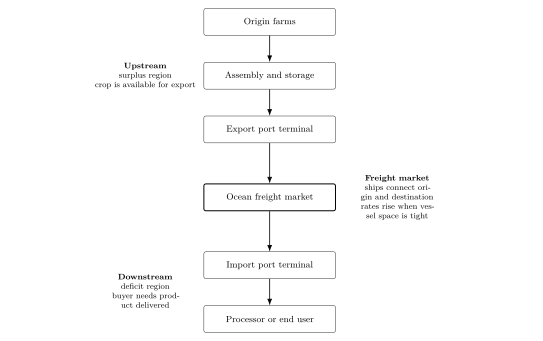
Freight as the strategic link in bulk commodity supply chains
The implications of freight differ among participants according to their roles in the commodity supply chain. For farmers, freight is a market-access mechanism. Most farmers are located far from major consumption hubs and export terminals. When inland logistics and ocean freight are cheap and reliable, farmers can reach more buyers and larger markets. When freight is less efficient or becomes constrained, local production surpluses can form even during strong demand, pushing prices down at origin and stressing farmer finances. This dynamic was starkly evident during the World Wars when shipping bottlenecks caused grain surpluses to pile up at ports, threatening the livelihoods of producers as they were unable to ship their goods and due to the unforeseen nature of the event, they did not have the infrastructure to store it either Dennis Voznesenski (2024).
For commodity traders, freight is not just a logistical or cost concern; instead, it is integral to whether a trade can be executed profitably while keeping risk under control. For instance, a trader buying FOB and selling CFR (Cost and Freight) or CIF (Cost, Insurance and Freight) must supply the commodity and arrange and pay for carriage to the named destination port. Under CIF, the trader must also arrange insurance. Under both CFR and CIF, delivery and risk transfer occur when the goods are placed on board the vessel at the port of shipment. Delays at the FOB stage, such as vessel unavailability or port congestion, can cause a missed shipment window, lead to default or trigger contractual penalties. Any delays at the FOB stage, such as vessel unavailability or port congestion, can cascade into missed CFR delivery windows, potential default and contractual penalties. Freight management therefore becomes an integral part of trading strategy and risk management. Scale matters here again as a source of operational resilience because traders with broader networks and resources can secure additional vessel supply, re-route flows through alternative supply chains and draw on stronger logistics expertise to ensure performance.
For downstream buyers, freight is the difference between "we bought it" and "we received it". Crushers, mills, refineries, and other industrial consumers often operate with tight throughput planning and limited ability to pause production. They value delivery reliability and timing as much as price. When freight markets tighten, delivered costs rise and lead times become uncertain, forcing buyers to draw down inventory, reduce utilisation or switch origin. This is why freight conditions translate directly into procurement decisions and pricing strategy.
Freight is therefore more than logistics. It is a market access mechanism for farmers, a contract performance constraint for commodity traders and a delivery reliability constraint for downstream buyers. Viewing freight through these lenses better explains why debates on investment in storage, port capacity, and shipping availability feed directly into prices and into whether commodity supply chains can function smoothly at all.
Evolution of Commodity Supply Chains
Commodity supply chains did not become global and freight-dependent overnight. They evolve as the cost, speed and reliability of moving bulk cargo improved. The underlying economic logic has always been the same, i.e. moving commodities from surplus regions to deficit regions, but the organisation of that movement has changed Martin Stopford (2009). As transport became cheaper and more predictable, production and consumption could afford to separate geographically at scale and supply chains stretched into the global networks we recognise today.
Early bulk trade was constrained by slow sailing speed, limited port capacity and unreliable schedules. Over the 19th and early 20th centuries, advances in shipping technology and trade networks transformed the scope and scale of maritime commerce. The Industrial Revolution in the 19th century brought about an unprecedented demand for raw materials and railroads complemented this expansion by connecting inland production to port terminals. Ships grew larger and innovations like steam-powered engines enabled faster, more reliable voyages. This period was a turning point, underscoring the strategic role of efficient supply chains in unlocking economic growth on a global scale and establishing trade corridors. Origins could specialise in production, destinations could specialise in processing and consumption, and freight became the bridge between them.
A major milestone in the 20th century was the drive toward standardisation and process efficiency in logistics. The most visible example is containerisation, which standardised cargo units and interfaces between ship, rail and truck. It reduced handling time, damage, and coordination friction, and made global supply chains far more interconnected and efficient Marc Levinson (2006). Even though bulk commodities move differently from containerised goods, the principle carries over: standardised interfaces and better port processes reduce friction, widen feasible trade routes, and increase the speed at which supply chains can adjust.
From the late 20th century onward, the next leap was information. Computerisation enabled real-time tracking of goods, predictive forecasting and streamlined inventory management. These advancements transformed logistics from a manual, paper-based process into a sophisticated, data-driven system capable of responding to changes in demand and supply with remarkable speed. Warehousing, routing and inventory systems became more efficient, facilitating just-in-time production and minimising storage costs.
The era of globalisation was marked by trade liberalisation, reduced tariffs and standardised trade practices, which expanded maritime trade and deepened interdependence across regions. As seaborne transport became cheaper and more predictable, it became economically efficient to produce where conditions were best and ship to where demand was strongest. Take the global grain trade, for example. Regions with high grain production, such as North America and parts of Europe, export to deficit regions in parts of Africa and Asia. Through efficient maritime supply chains, grain surpluses are shipped to regions facing deficits, stabilising food prices, supporting local economies and helping to alleviate food insecurity.
However, as supply chains grow more complex and lengthen, they also become more vulnerable to disruptions. Today's maritime supply chains are influenced by numerous factors, from economic policies and environmental concerns to geopolitical tensions and technological advancements. A delay or blockage in one part of the chain can have far-reaching consequences, as seen in recent global events like the 2021 Ever Given blockage of the Suez Canal.
While maritime trade has expanded, commodity supply chains have evolved into a tightly connected network with increased sensitivity to shocks. This evolution leads directly to the next question. If supply chains are longer, more specialised, and more time-sensitive than before, then competitive advantage increasingly depends on who can coordinate the chain, absorb disruptions, and reliably execute delivery. That is a question of market structureMarket StructureMarket structure defines how a market is organised, including the number of buyers and sellers, product differentiation and entry barriers. It shapes competition, pricing power and efficiency within an industry.Open in terminology: who has the capability to perform, who can enter, and how those advantages are changing.
Market Structure in Transition
In bulk commodities, market structure is shaped less by who has the best price but more by who can coordinate execution across a long and fragmented supply chain. Historically, many major trading corridors have been dominated by a relatively small set of large trading houses and specialised intermediaries. Their advantage is not only scale in trading volumes, but scale in logistical capability: access to origins, access to storage and terminals, freight execution and financing. Those capabilities became natural barriers to entry.
Over the past decade, this market structure has begun to shift along two dimensions: First, competition for end customers has increased. Smaller and mid-sized traders have increasingly sought to bypass traditional intermediaries and sell directly to industrial customers, especially in fast-growing emerging markets. Several conditions have enabled this. For example, information has become more transparent and faster to access; trading specifications and contract frameworks have become more standardised; financing is available to a wider set of counter-parties than before.
As a result, this shift introduces more sellers into the market, allowing new or smaller traders to capture market share in markets that were previously dominated by larger intermediaries. However, the shift comes with a trade-off, as it pushes more operational complexity onto the new players. Without integrated infrastructure and execution depth, smaller players can struggle to access the main "motorways" of global trade consistently. In practice, the market becomes more open at the margin, while scale remains decisive in the core flows.
Second, bulk commodity supply chains now involve a broader set of stakeholders than the simple model of producer, trader and buyer suggests. Modern bulk flows depend on a wider ecosystem, such as farmers, processors, terminal operators, large multinational traders, logistics providers, financiers, retailers and procurement managers, each influencing whether a shipment performs. Coordination among stakeholders within this ecosystem becomes the key. Digital tools such as predictive analytics and artificial intelligence, improve visibility and are claimed by vendors to reduce inefficiencies along the supply chain. These technologies do not eliminate the advantages of large scale, but instead can lower informational barriers and transaction costs, making parts of the market more contestable. In fact, digitalisation tends to help smaller firms compete where competitiveness depends on speed and customer-specific execution, rather than ownership of a large number of assets or global networks.
Carry the model forward.
Key Takeaways
Commodity supply chains are fragmented in practice; prices provide the “glue” that coordinates decisions across actors, regions and time.
Traders create value by executing across gaps in the chain, reducing transaction costs, managing risk and preserving optionalityOptionalityOptionality in commodity supply chains provides flexibility to adapt sourcing, logistics and delivery routes based on market conditions, costs, or demand shifts. This adaptability helps manage risks and capture pricing advantages.Open in terminology.
Freight is a strategic link in commodity trade because it determines whether surpluses can reach deficit regions.
The rest of the book develops this logic from economic principles to tradable freight decisions.
Connection to the Next Chapter
This chapter explains why freight matters in agricultural supply chains. The next chapter explains how prices, competition, and incentives work, providing the economic language used throughout the remainder of the book.
Continue to Economics